Best-first, A-star and Beam Search
1. Best-first search algorithm
(1) Introduction of the theory
The best-first search algorithm[1], or as said,
However, in real applications, we do not know the distance of every point to the target, so the distance is often a heuristic value, that not consider some other cases, for example, for a robotic search with some blocks in the path, we just take :
In every step, it greedily takes the position with the smallest distance.
(2) Code Example
1. Initialization
Consider a robotic way planning problem, that has some blocks in the way to search for the optimal path within the limited time. An example can be made by following initializations :
import numpy as np
from dataclasses import dataclass
from typing import Dict, List, Tuple

Position = Tuple[int, int]

# A small warehouse: 0 = free floor, 1 = shelf/wall.
WAREHOUSE_MAP = np.array([
    [0, 0, 0, 1, 0, 0, 0],
    [1, 1, 0, 1, 0, 1, 0],
    [0, 0, 0, 0, 0, 1, 0],
    [0, 1, 1, 1, 0, 0, 0],
    [0, 0, 0, 0, 0, 1, 0],
])

START: Position = (0, 0)
TARGET: Position = (6, 4)

MOVES: List[Position] = [
    (0, -1),  # north
    (1, 0),   # east
    (0, 1),   # south
    (-1, 0),  # west
]


@dataclass
class SearchState:
    grid: List[List[int]]
    start: Position
    target: Position
    visited: set[Position]
    queue: List[Position]    # the queue of positions to explore next
    parent: Dict[Position, Position | None]


def manhattan_distance(point: Position, target: Position) -> int:
    """Cheap estimate of remaining walking distance, ignoring shelves."""
    return abs(point[0] - target[0]) + abs(point[1] - target[1])


initial_state = SearchState(
    grid=WAREHOUSE_MAP,
    start=START,
    target=TARGET,
    visited={START},
    queue=[START],
    parent={START: None},
)

# Example heuristic values available to the planner:
start_estimate = manhattan_distance(START, TARGET) # 62. Algorithm
def best_first_search(state: SearchState) -> List[Position] | None:
    """
    Perform a best-first search to find a path from start to target.
    """
    while state.queue:
        # Sort the queue based on the heuristic (Manhattan distance) to the target
        state.queue.sort(key=lambda pos: manhattan_distance(pos, state.target))
        current = state.queue.pop(0)  # use the position with the lowest heuristic value

        if current == state.target:
            # Reconstruct the path from start to target
            path = []
            while current is not None:
                path.append(current)
                current = state.parent[current]
            return path[::-1]  # reverse the path to get it from start to target
        else:

            state.visited.add(current)

        # explore all valid neighboring positions
        for move in MOVES:
            neighbor = (current[0] + move[0], current[1] + move[1])
            is_valid_move = (neighbor[0] >= 0 and neighbor[0] < state.grid.shape[1]) and \
                            (neighbor[1] >= 0 and neighbor[1] < state.grid.shape[0])
            if not is_valid_move:
                continue

            is_possible_move = (state.grid[neighbor[1], neighbor[0]] == 0)
            if not is_possible_move:
                continue

            # attention : marking a node visited only when popped allows
            #   the same neighbor to be added to queue multiple times before its first turn
            # we also note here, if the path has length, we need to update the minimal length
            if neighbor not in state.visited and  neighbor not in state.queue:
                state.queue.append(neighbor)
                state.parent[neighbor] = current

    return None  # No path found


if __name__ == "__main__":
    path = best_first_search(initial_state)
    if path:
        print("Path found:", path)
    else:
print("No path found.")(3) A-star search algorithm
A-star algorithm[2][3] is a pathfinding algorithm in the computer science and robotics traveling. The thought is completely same as the Best-first algorithm, with the only difference being the evaluation function.
For
According to the essay[3:1], We firstly suppose that some function
- Mark
as open and compute - Select the node
with smallest , Resolve ties arbitrarily, - if
(is the target), mark the as "closed" and terminate the algorithm. - otherwise, still mark
closed, and apply the successor operator to , calculate for ==each successor== of ,
We note the successor here is the sub-branch. But since possible solution is
Also, we note the
where
where
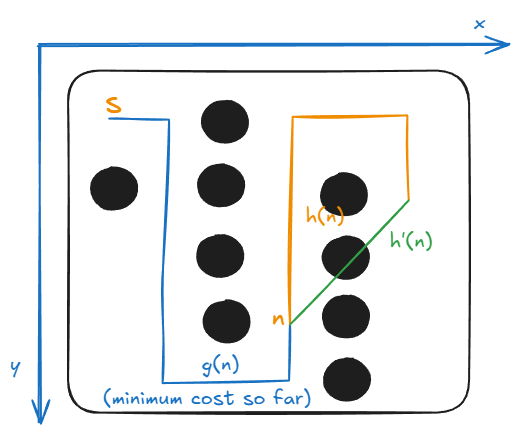
To give the code of it, we modify the initial state :
# A small warehouse: 0 = free floor, 1 = shelf/wall.
WAREHOUSE_MAP = np.array([
    [0, 0, 0, 1, 0, 0, 0],
    [1, 1, 0, 1, 0, 1, 0],
    [0, 0, 0, 0, 0, 1, 0],
    [0, 1, 1, 1, 0, 1, 0],
    [0, 0, 0, 0, 0, 1, 0],
])Then the code of
def a_star_search(state: SearchState) -> tuple[dict[Position, int], List[Position] | None]:
    best_dist_sofar = {state.start: 0}  # distance from start to each position

    while state.queue:
        # Sort the queue based on the heuristic (Manhattan distance) to the target
        state.queue.sort(key=lambda pos: best_dist_sofar.get(pos, float('inf')) + manhattan_distance(pos, state.target))
        current = state.queue.pop(0)  # use the position with the lowest heuristic value

        if current == state.target:
            # Reconstruct the path from start to target
            path = []
            while current is not None:
                path.append(current)
                current = state.parent[current]
            return best_dist_sofar, path[::-1]  # reverse the path to get it from start to target
        else:
            state.visited.add(current)

        # explore all valid neighboring positions
        for move in MOVES:
            neighbor = (current[0] + move[0], current[1] + move[1])
            is_valid_move = (neighbor[0] >= 0 and neighbor[0] < state.grid.shape[1]) and \
                            (neighbor[1] >= 0 and neighbor[1] < state.grid.shape[0])
            if not is_valid_move:
                continue

            is_possible_move = (state.grid[neighbor[1], neighbor[0]] == 0)
            if not is_possible_move:
                continue

            # attention : marking a node visited only when popped allows
            #   the same neighbor to be added to queue multiple times before its first turn
            # we also note here, if the path has length, we need to update the minimal length
            if neighbor not in state.visited and  neighbor not in state.queue:
                state.queue.append(neighbor)
                state.parent[neighbor] = current
                if current not in best_dist_sofar:
                    raise ValueError(f"current {current} not in best_dist_sofar")
                best_dist_sofar[neighbor] = best_dist_sofar[current] + 1

return best_dist_sofar, None # No path found2. Beam-Search Algorithm
(1) Introduction
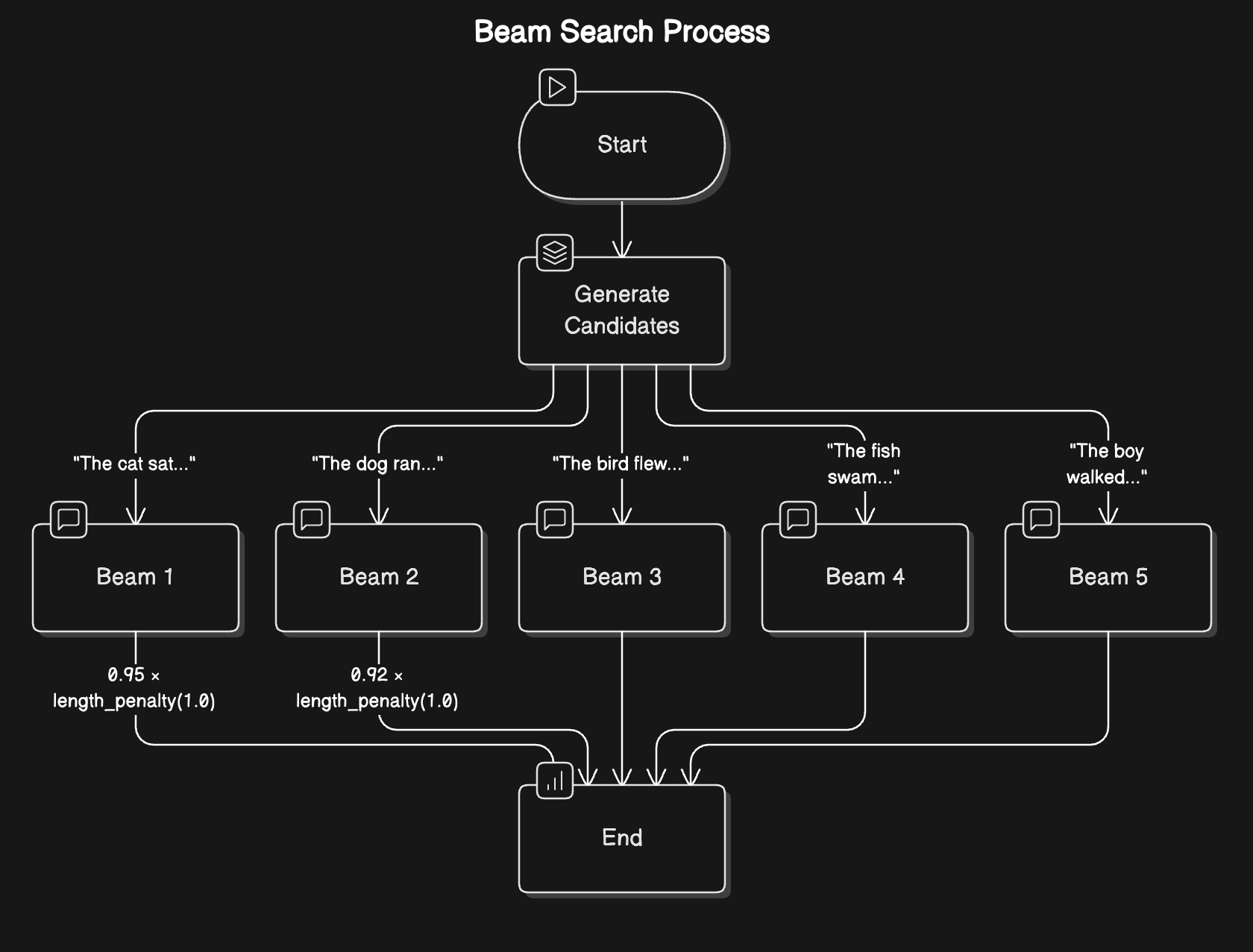
The beam-search algorithm [4] allows to explore multiple possible paths simultaneously. It is a modification of the Best-first search algorithm. It is also a heuristic search method. Such a search algorithm is useful for the planning of the next state. For example, planning for the next move. In beam search, only a predetermined number of best partial solutions are kept as candidates.
In RL, a value estimate is usually not guaranteed to be accurate or admissible.
The beam search ==only keeps the best B partial cube states at every depth==, which can reduce the memory requirements for the search.
| Property | A* | Beam search |
|---|---|---|
| Finds a solution | Yes, in a finite state space | Not guaranteed |
| Finds shortest solution | Yes, with admissible h | No |
| Memory use | Can be large | Fixed by beam width |
| Uses RL policy well | As ordering/tie-breaker | Very naturally |
| Risk | Slow or memory-heavy | May discard the only path to solution |
The beam search is often used by LLM inference [5], behavior prediction and the action taking process. This is the reason why we often get multiple responses in LLM models.
(2) Code Implementation
We note the beam-search is not simply apply a queue clipping into the best-first-search algorithm, the standard beam search is level-based :
- Expand every state in the current frontier, up to
beam_width. - Combine all their children.
- Keep the best
beam_widthchildren as the next frontier. - Repeat at the next depth.
def beam_search(state: SearchState, beam_width: int = 3) -> List[Position] | None:
    """
    Perform a beam search to find a path from start to target.
    """
    beams = [state.start]  # Initialize the beam with the start position

    # we use the queue as the child node set (stop until it becomes empty)
    while beams:
        state.queue.clear()  # Clear the queue for the next layer of child nodes
        # search a layer under the current beam.
        beams.sort(key=lambda pos: manhattan_distance(pos, state.target))
        beams = beams[:beam_width]  # Keep only the top beam_width positions

        # Keep only the top beam_width positions
        for beam in beams:
            if beam == state.target:
                # Reconstruct the path from start to target
                path = []
                current = beam
                while current is not None:
                    path.append(current)
                    current = state.parent[current]
                return path[::-1]  # reverse the path to get it from start to target -> here we only return the first beam
            else:
                state.visited.add(beam)

            # explore all valid neighboring positions
            for move in MOVES:
                neighbor = (beam[0] + move[0], beam[1] + move[1])
                is_valid_move = (neighbor[0] >= 0 and neighbor[0] < state.grid.shape[1]) and \
                                (neighbor[1] >= 0 and neighbor[1] < state.grid.shape[0])
                if not is_valid_move:
                    continue

                is_possible_move = (state.grid[neighbor[1], neighbor[0]] == 0)
                if not is_possible_move:
                    continue

                # attention : marking a node visited only when popped allows
                #   the same neighbor to be added to queue multiple times before its first turn
                # we also note here, if the path has length, we need to update the minimal length
                if neighbor not in state.visited and neighbor not in state.queue:
                    state.visited.add(neighbor)
                    state.parent[neighbor] = beam
                    state.queue.append(neighbor)   # child nodes
        # after exploring all beams, we update the beams to be the next layer of child nodes
        beams = state.queue.copy() # Move to the next layer of child nodes
    return None  # No path found